
Home
What's a House Rabbit?
Fosters
Adoptions
Library
News
Videos
Resources
Sponsors
Radkos
Contact
Site Map
Download a formatted PDF of this page here.
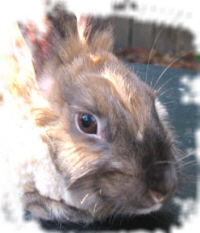
This page is dedicated to the memory of Peaches; a beautiful, brave, sweet, & spirited girl who faced one too many close calls during her short life.
Fleas on Rabbits
Depending on conditions (where you live, whether your rabbits are allowed outside, whether you have other animals, and whether the effects El Nino and El Nina are truly history), you may be wondering if the impending flea season is going to affect your furry family.
Flea treatments are a common concern of rabbit owners - what's the best way to get rid of them, without risking harm to your bunny? We did some checking around - and consulted with our own Dr. Marianne Brick of the Madison Avenue Veterinary Clinic - to find out what's out there, what works and what doesn't.
Unfortunately, it's not as simple as it seems; when it comes to determining the "best" products on the market, it seems that the jury is still out among even the most educated veterinarians. Many non-rabbit-savvy vets will tell concerned rabbit owners that any product that is approved kittens can be used on a rabbit, and that this is the best way to go. STOP! This is not necessarily true. Following is a list of some of the most common ways of treating fleas, and the arguments for and against them.
Flea powders.
Dust your rabbit with 5% carbaryl insecticide (a common brand name is 5% Sevin Dust) working the dust down through Bunny's thick fur to the skin. Bunny might try to lick some of it off; assuming he doesn't go overboard, this is probably all right. Most of the powder is just a carrier agent, and there's very little of the active ingredient in the mix. Another important warning from the San Diego HRS: "There are "all natural" flea powders sold at many pet and health food stores and in catalogs. These powders mainly contain pennyroyal (very poisonous), peppermint, eucalyptus or other herbs. Do not assume that these are safe just because they are in a health food store or are herbal. Herbs and "natural" products contain chemicals, such as the chrysanthemum derivative pyrethrin, designed to kill insects or fungi; they can also have lethal effects on mammals. Some of these herbs may even be safe for humans to eat, but can kill rabbits."
Flea dips (baths).
Some grooming houses (and even vets) will do this upon request, but it is highly discouraged by the HRS. According to HRS founder and director Marinell Harriman, "We have never recommended a flea dip for rabbits, and recently we received a very alarming report of a death occurring after a flea shampoo, followed by a pyrethrin dip. We cannot be certain as to the specific cause of death -- the stress of the bath or the ingredients in the shampoo or dip - so we recommend avoiding both."
Flea combs.
This approach alone probably won't solve the problem, but it's definitely an important part of the equation. Be sure to check around the ears and legs for places where fleas might hide. Drown captured fleas in water or alcohol.
Flea collars.
Don't even think about trying this approach. Not only do rabbits hate restraints around their necks, but remember that most flea collars are treated with a chemical dose that is measured for much heavier animals (dogs and cats). A potential quick fix isn't worth the risk of accidental overdose.
Upkeep and housecleaning.
It may seem like a silly point to make, but prevention really is the best approach. Regular vacuuming and occasional steam-cleaning will help keep down the risk of flea infestation and contribute substantially to your bunnies' comfort. Have your carpet annually treated with sodium polyborate (boric acid) or fenoxycarb (an insect growth regulator in the form of a synthetic hormone).
What about topical products, such as Advantage or Frontline?
Frontline will kill Rabbits. We have seen this many times. Frontline's FAQ page says not to apply to rabbits
Topical products are gel-like substances that come in little pre-measured tubes. You apply the solution to your pet's neck, and you don't have to treat the household or surrounding areas. But before you try this approach, make sure you know what you are buying! Advantage, made by Bayer, is the only topical product that is tried and tested safe for rabbits that is available over the counter. Dr. Brick says that Advantage is "a lot less hassle than the other stuff," and adds that she considers it a safe product for adult bunnies (she has seen only rare topical reactions from using Advantage, and even then, it was nothing serious). In general, a very small or dwarf rabbit should be treated with half of a pre-filled tube for kittens or small cats; bigger rabbits can be given a full dose for appropriate weight. Because it takes a while for such topical flea treatments to disseminate through a dog or cat's coat, the HRS recommends that rabbits be kept apart from other animals that have been treated for at least 12 hours. Check with your veterinarian for specifics. Advantage was reformulated and is now labled as Advantage II. This new formulation has treatment for other parasites in addition to fleas. Although still generally safe for rabbits, some rabbits have shown more sensitivity to this new formula. Revolution, available only by prescription, treats fleas and mites safely.
Whatever you do, don't try to save money by buying a cheap knock-off of Advantage.
Similar-looking products, such as Bio-Spot by Hartz, can be purchased in the grocery store, but those products contain permythrin, which can make cats have seizures. "I wouldn't even chance it with a rabbit," says Dr. Brick. Frontline, by Rhone Merieux Inc., is also considered highly unsafe for bunnies. Even the manufacturer has admitted that this product can cause "adverse reactions" in rabbits.
Dr. Brick says you will likely never find a product that is marketed especially for rabbits, simply because it wouldn't be cost-effective for manufacturers to focus on such a small group of pet owners. However, she points out, many of these cat-and-dog products are first tested on rabbits, prior to being approved and mass-manufactured. If in doubt about any particular product or approach, of course, the safest and smartest thing to do is to consult your veterinarian to double-check.
If you have no choice but to use products not recommended here, there are often 800 phone numbers on the package of over-the-counter products. You should call these numbers to ensure that the product is safe for rabbits. This number should also provide antidote information should it become necessary. If the rabbit has an adverse reaction, you should wash the treatment from the skin with mild shampoo & soap, then take the rabbit to the vet. At the vet the rabbit will be given IV fluids to help rid the chemicals from their system.