
Home
What's a House Rabbit?
Fosters
Adoptions
Library
News
Videos
Resources
Sponsors
Radkos
Contact
Site Map
Download a formatted PDF version of this file here.

"It is not easy to manage young humans and animals, but when parents find solutions, rather than dispose of an animal for convenience sake, an important concept is communicated to the child. This is alive. This is valuable. You don't throw it away." -Marinell Harriman, Importance of Permanence.
BUNNY RULE # 1:
Gentle petting. Sit on the floor with child in your lap while you pet and talk to the rabbit. Guide her hand over the rabbit's head, ears, and upper back. To prevent fur-grabbing, hold her hand flat or use the back of her hand. Do this frequently but no longer than 5 minutes at a time.

BUNNY RULE #2
Leave the rabbit alone when he hops away or goes in his cage. Interpret rabbit's body language for the child ("Oops, he didn't want anymore petting. He wants to eat or take a nap.)
Prevent the tendencies to chase a rabbit who has had enough and to bang/poke on the cage by explaining: "Chasing him will make him scared of you" or "Banging on his house scares him."
Watch your child carefully and make such explanations at the moment before it looks like the child may engage in such behaviors. Explaining, then redirecting the child's attention works best when inappropriate behavior seems imminent or occurs.
BUNNYRULE #3:
Don't touch droppings and litter. Teach the child that the litterbox and droppings that may be found on floor are "dirt". You may have no problem with picking up the dry droppings with your hand, but you don't stick your fingers in your mouth! You may have to change your habits for awhile to teach this concept. A box with a cage floor wire grate works well.

BUNNYRULE #4:
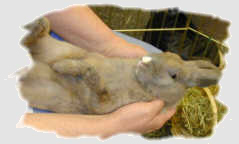
We pet, but don't pick up the rabbit. Explain that it scares the rabbit to be picked up and both of you could get hurt. Explain that Mom or Dad may pick up the rabbit if she needs care. Explain rabbit language and actions: "Hear her teeth clicking? She likes the petting. See her toss the ball? She's playing."
If child gets scratched, explain what the child did to scare or hurt the rabbit and show a better way to act. Redirect loud play to another area ("Look at bunny. She doesn't like the noise.")
Toddlers love to share their snacks with the rabbit so make sure rabbit gets only small amounts of proper foods and is not overloaded with cereals and crackers. They also love to help with feeding-scooping and pouring food, taking vegetables and hay to rabbit.

Rabbits and Children
by Carolyn Mixon
Are you thinking of getting a rabbit for your child?
- Are you trying to figure out how to live with both a rabbit and a child since having a baby?
- Does your family already have a rabbit?
- Are you finding that the children and rabbit do not interact as you had expected?
- Did your family agree that the rabbit would be the "children's responsibility" and now that is not happening?
Then, please read on!
Children and rabbits are natural companions-right? The answer could be yes, no, or maybe so depending on many factors.
What's a Rabbit Really Like?
Many people are surprised and disappointed to find that rabbits rarely conform to the cute-n-cuddly stereotype in children's stories. Baby bunnies (and many young adult rabbits) are too busy dashing madly about, squeezing behind furniture, and chewing baseboards and rugs to be held. Also, rabbits are physically delicate animals which means they can be hurt by children picking them up. Because rabbits feel frightened when people pick them up, they kick and struggle which means children can also get hurt. Rabbits are built to react to sudden changes which means they may either run away or try to bite when approached too quickly and too loudly. Stress-related illnesses are common. For these reasons, many children, especially young children, will find it difficult to interact with a rabbit and soon lose interest. So why do they make good house pets? Rabbits:
- are quiet can learn near-perfect litter-box habits
- are fun to watch
- have different personalities just as individual dogs and cats do
- don't need a yard if given plenty of indoor, sun-lit exercise space.
In addition, rabbits are social animals meaning they need the companionship of humans or other animals, although the need may vary among individual rabbits. They play, some more than others. Many can get along with most cats and some dogs when properly introduced. Many enjoy being with people, but your family must have patience, understanding, and an acceptance of individual differences to earn their trust.
In order for a family and a rabbit to get to know each other (and for the rabbit's best health), the rabbit needs to be an indoor pet with as much out-of-cage time with the family as possible. If you relegate your rabbit to an outdoor hutch (or even to an indoor cage for most of the day), your family will miss getting to know the special personality of the rabbit.
As the adult, you need to get used to this idea: The rabbit will be your pet. If your family already has a rabbit whom "the children were supposed to care for" and there are problems with this, then try to reconcile yourself to the fact that a rabbit is an adult's responsibility. Rabbits are very sensitive to changes to their feeding, cleaning, and exercise routines.
Changes are stressful and may lead to illness. Symptoms of illness are often subtle changes in appetite, behavior, and/or droppings that even mature children will miss. It is unreasonable to expect a child of any age to take responsibility for care of a rabbit (or any pet). The rabbit and your children, as well as the family peace, will benefit greatly from you accepting this notion. If your family is considering adopting a rabbit, decide how you and the other adults in the household feel about taking on the responsibility of a rabbit. Do the adults want a rabbit as a member of the family?
If the rabbit is an all-around family member (lives indoors, gets regular out-of-cage time) and play with the rabbit is supervised, then a child and rabbit can get to know each other and live together happily. Do the adults have an understanding of the basic nature of rabbits and what to expect in terms of time, training, and cost? Or, are you open to finding out? Are the adults willing to make a 5 to 10 year commitment? Unless the adults of the household are enthusiastic, informed, and committed about the work involved, a stuffed animal rabbit is a better choice.
Other Factors to Consider: Amount of Time & Patience You Have to Devote
You don't have to be "Super-Adult" to have peaceful coexistence between rabbit and children. But, do you want another "toddler"? Rabbits are a lot like 2 year old children-they can be a joy to live with, but:
- You will need to spend time in "toilet-training"(i.e. litterbox training) and have tolerance for accidents. Most rabbit people take occasional scattered droppings in stride. There may be an occasional puddle, usually done to mark new territory.
- You will need to bunny-proof the parts of your house where the rabbit is allowed to run somewhat similar to toddler-proofing.
- You will need to check on your rabbit often and supervise child/rabbit inter-actions when the rabbit is out for exercise. Three to four hours per day of out-of-cage time is the minimum.
- Some of your things may be partially ruined. The amount of chewing and digging that your rabbit does will depend on age, personality, whether spayed/neutered, as well as on what toys you provide him.
- Your rabbit will need toys, which can be store bought or home made.
- Just like human toddlers, rabbits respond to routines for feeding, playing, and cleaning up. The main thing is to find a routine that is easy for you. If the routine is too difficult, you will begin to look at the rabbit as one more mess-maker.
- A rabbit, like a child, responds best to situations that are set up so he will do the right things and receive praise for doing right instead of punishment for doing wrong.
Your Child's Personality
If your child is generally easy-going, calm, gentle, and cooperative, you may enjoy having a rabbit as a member of the family. If your child is generally on the loud side, very active, tends to interact physically/ aggressively, or frequently seems to need reminders about or challenges rules, she or he may find it difficult to build a relationship with a rabbit and you may find that a rabbit is an additional stress.
Number of Children and Ages
Contrary to Easter-time hype, rabbits are rarely a good choice for a small child (younger than 7 years). The natural exuberance, rambunctious ness, and decibel-level of the average toddler is stressful for most rabbits. Children want a companion they can hold and cuddle; Rabbits need someone who understands that they are ground-loving creatures. The guidelines below are based on what children of varying ages are genuinely like while keeping in mind the type of household most rabbits do well in. Of course, rabbits and children do vary and there may be exceptions to these guidelines. The most important factor is most likely the adults' attitude and knowledge level.
One Child Younger than 7 Years
1. Probably shouldn't get a rabbit unless your child fits the "calm" description and you are an informed adult who wants to deal with another toddler. It can be done though, if you have the time and patience.
One or More Younger than 7 Years
2. Probably shouldn't get a rabbit. You are likely very busy with active children who need a lot of your attention which will probably leave you little time for managing a rabbit.
One Younger than and One Older than 7 Years
3. Perhaps. Your time, the children's personalities, and the general noise/activity level of your household should be considered. If your younger child is on the move and into everything, it may be difficult for you and rabbit to live happily even if the older child is of the "calm" type.
One or More Older than 7 Years
4. Perhaps. Again, your time, the children's personalities, and the general noise/activity level of your household should be considered. Lots of friends coming and going will probably stress out a rabbit. Your children may also be involved in quite a few activities(music lessons, sports, etc.) which may leave little time for the rabbit and family to get to know each other.
One Younger and One or More Older than 7 Years
5. Probably shouldn't get a rabbit. Consider the information in 3 and 4 above, but your household is most likely too busy and noisy to build a friendship with a rabbit. Caring for and training a rabbit may be "just one more thing" that the adults have to do.
Two or More Younger than and One or More Older than 7 Years
Probably shouldn't get a rabbit. Consider the information in 2.-5. above.
One Child Older than 7 Years
If you are enthusiastic about accepting responsibility for a rabbit and if your child is the calm type or at least generally accepting of rules for behavior, you and a rabbit would probably find it a joy to live together. If your child if of the loud/active/ challenging rules variety, a rabbit may just increase your stress level.
Money
As with any pet, rabbits require a commitment in terms of housing, feeding, and medical care for their natural lives. The biggest initial expenses will be a cage ($75 and up) and a spay ($65-120)or neuter ($45-75) operation if this was not done prior to adoption. Rabbits do not need annual shots but you will need to visit a veterinarian if she is sick. You will need to keep supplies of litter, food pellets, fresh vegetables, and hay on hand.
Space
Rabbits should be kept indoors for health, safety, and socialization. You will need space for at least a 30" x 30" or 24" x36" cage. The cage should be away from TV's, stereos and high noise areas, but not completely isolated from people. Consider which area is most easily bunny-proofed for your rabbit's out-of-cage time.
Allergies
If any of your family has allergies, you should have testing done to see if there is an allergy to rabbits before you get a rabbit.
New Baby in the House?
If a baby is coming, or has come, to your house, your rabbit will probably be getting less of your attention for awhile, but neither of you needs to suffer. You may not have time for lots of petting and playing, but focus on maintaining the rabbit's daily care routine. It can be relaxing to have some petting time with your rabbit when baby sleeps. Rabbit will adjust! Your rabbit will be infinitely happier with you than if he is given away to adjust to a new home. Shelters and rescue groups overflowing with dogs, cats, and yes, rabbits, are constant reminders of how difficult it is to find people willing to give an animal a good home for life. Many are initially enthusiastic about getting a new pet, but when the newness wears off and the reality of care sets in, many animals find themselves disposed of for the owners convenience. When baby gets older, the rabbit will have added attention from your child (and you), which can be a good thing if you are committed to teaching your child about the rabbit.
Teaching
Children to be Rabbit People Whether you have brought a baby home to your rabbit's house or have brought a rabbit home to your child's house, it is well to remember to:
- Learn about rabbit behavior/language so you can point out the rabbits feelings about your child's actions. Choose a time of day when your child is on "low ebb" for teaching your child about the rabbit and for play with the rabbit.
- Set your child and the rabbit up for success. Try to anticipate and prevent inappropriate interaction by often showing your child how to interact.
- Try not to get into a pattern of always saying "Don't…" and "Stop…" to your child about the rabbit. If your child does something inappropriate, show and talk about what the child can do with the rabbit. Offer choices for behavior and ask "What could you do…?" Otherwise, your child may see the rabbit as something he is always getting in trouble for.
- Keep the child away from the rabbit for a short time if the child refuses to stop a behavior that may hurt the rabbit.
- Set up the cage so rabbit can get away from the children-"a safe zone". Use child gates in doorways and or turn the cage so the door faces the wall with enough room for rabbit but not the child.
- Put the rabbit in a closed-off room when there are lots of playmates or parties. It is often better if the guests don't know the rabbit exists.
- Refrain from having children's friends in to see the new rabbit for the first week or so.
- Show children's friends where rabbit lives and how to pet at times when only 1 or 2 friends visit, then make sure the rabbit is safe during the visit.
What You Can Do with Different Ages
Sitting/Crawling Infants (6-12 months)
Start teaching the idea that the rabbit is to be respected and treated carefully.(See "Bunny Rules" sidebar below.)
Toddlers (1-2 yrs.)
Continue reinforcing or teach Bunny Rules #1-3 and add #4. Although unintentional, toddlers are capable of doing real harm to a rabbit. They will need constant supervision and frequent gentle reminders of appropriate behavior. Due to still-developing muscle coordination, toddlers have a hard time keeping fingers out of rabbits' eyes so you may have to insist on two-finger petting or back-of-hand petting. Closely supervise children's interactions with the rabbit. This is the "stick stage" when some are prone to bash things with sticks. Children this age also have a hard time not chasing a rabbit who hops away. If she chases the rabbit, the rabbit will learn to be scared of her. Teach respect for the rabbit ending the petting or playing session ('Well, that's all he wanted to do.") and interest the child in another activity. Children who are interested in toilet-training can understand "that is where the bunny poops and pees".
One to Seven-Year-Olds
If a 2-year-old has grown up with a rabbit, she can have quite a bit of empathy for and knowledge about a rabbit. Continue or teach Bunny Rules #1through 4. Teach by example instead of by a lot of "No's"; Your child will learn most by watching you. If interested, the child may help with feeding and play with the rabbit with your supervision.
Older Children
Continue or teach Bunny Rules #1through 4. Teach by example and setting up situations for success. Your child may build a friendship with the rabbit by sitting on the floor with the rabbit while doing homework, art work, reading, or watching TV. The rabbit will eventually come to investigate and to be petted. Older children have lots of other interests and interest in rabbit may come and go. The rabbit's care should continue to be your responsibility, but your child may help with feeding and grooming.
Choosing a Rabbit
Rabbits have different personalities so it is difficult to make generalizations about breeds. In general though, a medium to large breed adult rabbit is usually better for a child. They will command the most respect from a child and are easier to pet because they have larger heads. Dwarf breeds tend to be more excitable, energetic, and aggressive. Baby rabbits are very active, often nippy, and chew everything in sight. Adult rabbits are more easily litter-and house-trained, especially after spaying or neutering. You will also have a better idea of a rabbits personality if you choose an adult who is spayed or neutered. Adopt a rabbit from a rescue group or local shelters. There are many advantages and you will be helping to combat rabbit overpopulation. Animal shelters euthanize hundreds of unwanted rabbits each year, many less than a year old. Many more die agonizing deaths from neglect and abandonment without ever reaching a shelter. You will be giving one of the many unwanted rabbits a second chance for a loving home while discouraging those who breed rabbits for profit.
Teaching Responsibility: Something to Think About
Many parents say they want to get a rabbit for their child to teach the child some responsibility. What usually happens is that the child loses interest (not to mention being incapable of sticking to a routine and providing proper care), and the rabbit suffers. The child, at best, learns to feel bad that she has failed and caused suffering. At worst, she learns to resent the animal for the nagging that she is hearing from the adult. Often, the rabbit is given away because the child didn't take care of it. The child learns that life is disposable and that if she waits long enough, someone else will relieve her of her responsibilities. So, let your child help with the rabbit, but don't insist. If the child appears interested, encourage her; if she becomes bored, let her move on to the next thing, and you carry on with the rabbit. She learns most of all from watching you-your actions, your tone of voice when you speak to the rabbit, and your attitude. From this she learns the nurturing (responsible) point of view-the patient waiting, the faithful caring, the joyful appreciation and acceptance of a living creature for who he is, not who you wish him to be.